Your Ad Here

Monday, 30 April 2012

Greylock Deepens Enterprise Experience, Adds Former BladeLogic CEO And BMC President As Venture Partner


dev
Greylock Partners has been long focused on two distinct areas when it comes to venture investments—consumer and enterprise. The last consumer partner hire the firm made was former CEO of Mozilla, John Lilly. And today, the firm is deepening its experience in its enterprise practice with the addition of Dev Ittycheria as Venture Partner in Greylock’s Silicon Valley office.
At Greylock, Ittycheria will be focusing on investing in enterprise software companies, with a focus on cloud-based services and enabling IT infrastructure. Ittycheria is a long-time enterprise veteran with a history of not only founding successful startups, but also helping lead established companies towards revenue growth. He co-founded BladeLogic, which he led through a successful IPO and eventually a sale to BMC Software in 2008 for $900 million.
Following the acquisition, Ittycheria was the President of BMC Software where he led BMC’s $1.4 billion enterprise service management business with more than 4,000 employees in over 25 countries. Prior to BladeLogic, he founded early cloud computing pioneer Applica, which merged with Brakeaway Solutions (Brakeaway went public in the late 1990s). He also had a brief role as Entrepreneur-In-Residence in Bessemer Venture Partners.
More recently, Ittycheria has been a startup investor and board member at several companies including Bazaarvoice, AthenaHealth and application management company AppDynamics (where Greylock is a founding investor). It was actually through his recent work with AppDynamics that he grew closer to Greylock partner Asheem Chandna, who also serves on the company’s board. Chandna tells us he felt that Ittycheria’s experience advising enterprise companies and leading his own ventures would fit perfectly with Greylock’s venture strategy.
Ittycheria, who has already started actively helping a number of Greylock companies think through and refine their go-to-market and distribution strategies, tells us jokingly that after having started, built and scaled two companies, he has lots of scar tissue, and enjoys helping advising other enterprise companies navigate through these waters. He explains, “I chose Greylock because they have amazing track record in both enterprise and consumer…It’s a great cultural fit.”
With the addition of Ittycheria, Greylock’s senior investing team in enterprise now includes six professionals, says Chandna.
Ittycheria explains that particularly interested in investing in companies enabling cloud servers and underlying management and IT infrastructure, including storage, big data, enterprise mobility, and security.
He adds that he believes that IT buying behavior has changed significantly since his days at BladeLogic. “Companies are realizing there’s not a lot of innovation coming out large incumbents in the enterprise. Today, because of the disruptive technologies coming out of startups, customers are much more open to working to smaller, innovative companies.” Because of this trend, he believes it’s a “great time to be en enterprise investor.”
Source:http://techcrunch.com/2012/04/29/greylock-deepens-enterprise-experience-adds-former-bladelogic-ceo-and-bmc-president-as-venture-partner/


Just-Eat Just Raised Another $64M From Vitruvian, Index, Greylock For Online Food Ordering


just eat logo
The UK may have just entered a double-dip recessionbut that doesn’t seem to have trickled down to how consumers are spending money on take-out food — and the companies that are building businesses around that. The UK-based online food ordering site Just-Eat has picked up a third round of funding totaling $64 million, its biggest yet, to further build out its online food ordering service.
The round was led by private equity firm Vitruvian Partners, with participation from existing investors Index Ventures, Greylock Partners and Redpoint Ventures. The investment comes only a year after the company raised a venture round of $48 million, and a Series A of $17.4 million in 2009, and brings the total funding in the company up to a whopping $129.4 million in the last three years.
Just-Eat will be using the money to expand into more markets outside of its current footprint of 13 countries in Europe — a footprint that Vitruvian’s managing partner Mike Risman says makes it the “world’s biggest takeaway e-commerce provider.” The FT cites figures from Experian Hitwise that say Just-Eat gets more hits than Domino’s and Pizza Hut.
That expansion will likely be the in form of entirely new operations but also acquisitions, something the company has already been active in doing, the company buying up Alloresto in France in February.
“This new investment will help our continued expansion. Takeaway e-commerce has massive growth potential,” said Klaus Nyengaard, the Copenhagen-based CEO who has been with the company since 2008 (it was originally founded in Denmark in 2000).
If a lot of e-commerce is about sorting out the logistics that makes it happen (for examples look at companies like Amazon, Ebay and KupiVIP — and more recently Uber, which may, longer term, try to use its network for more than just a car service), then Just-Eat is in a strong position for growth. The company says that it already covers 25,000 take-out restaurants in that 13-country footprint, and it sends out 100,000 meals per day.
The company says that it generates more than $750 million in revenue annually at the moment, but its own margins on that are pretty thin and shows why the company needs scale. Last year when it reported $500 million in sales generation, its own revenue bookings were only $10 million. Extrapolating from that, revenues for the $750-million year will be only $15 million unless there are better economies at scale or other efficiencies — and it appears that this is the case: the FT story notes that Just-Eat is projecting an annual run-rate of £60 million ($98 million) for this year. The company takes an 11 percent commission on all orders placed through the site, and says it has a 40 percent pretax profit margin in its most developed markets like the UK and Denmark, and less so in markets where it is still building itself up.
Vitruvian’s venture and private-equity activities focus on middle-market buyouts, growth buyouts and growth capital investments in Europe. The investment it’s making in Just-Eat is coming out of its inaugural fund of €925 million ($1.23 billion), which has also included investments in a variety of businesses in the tech/media/telecoms sectors as well as others. They include Tinopolis, Callcredit, Inspired Gaming, Openbet, Unicom, IMD, College Group, Flexpay and Healthcare at Home.

Microsoft Makes $300M Investment In New Barnes & Noble Subsidiary To Battle With Amazon And Apple In E-books


barnes_and_noble_nook_tablet_1161200_g2
Barnes & Noble has found a new, major partner in its fight to get an edge over Amazon and Apple in the market for e-books and the devices being used to consume them: it is teaming up with Microsoft in what the two are calling a strategic partnership, name yet to be determined.
It will come in the form of a new subsidiary of B&N that will include all of its Nook business as well as its educational College business. Microsoft is making a $300 million investment in the subsidiary, valuing the company at $1.7 billion in exchange for around 17.6 percent equity in the subsidiary.
The news leaves the door open for B&N to eventually spin these off into a separate business altogether — or even sell them to Microsoft. And it leaves a load of questions about what B&N will do next with the Nook, which is currently built on a forked version of Google’s Android platform.
The new company, referred to for the moment as Newco, will contain B&N’s digital business, as well as its College division. While Microsoft will take 17.6 percent, B&N will own 82.4 percent of the venture.
This is a key way of getting more content on to the Microsoft platform — specifically e-books content to ensure that its Windows 8 tablets will be able to compete not only against the best-selling iPad but also the Kindle Fire from Amazon, along with the rest of the company’s e-readers. The Kindle Fire has stolen a march among Android tablet makers and part of the compelling offer is not only the low price ($199) but also the fact that it contains so much content, including seamless access to all of Amazon’s e-book offerings.
This is also a progression — a very big one — of the funding etudes that Microsoft has been making to developers to make sure they are making apps for the Windows Phone platform, a way of getting more content on its platforms, which, it can be argued, may have come too late to the market. The first product to come out of the door? A Nook application for Windows 8, the companies say.
And given that education has been one of Apple’s bigger pushes this year, and the obvious and close links between education and e-reading, it’s not too surprising to see that B&N has also put its College division into this subsidiary. Microsoft, too, has been courting the education market — making its biggest-ever cloud-services deal in the education sector. Nevertheless they have a long road ahead of them. In January, Apple noted that there were already 20,000 educational apps for iOS and that there were already 1.5 million devices deployed in schools, numbers that will inevitably have grown in the last 4-5 months with the launch of the new iPad and numerous initiatives to spread the tablet in the educational sector.
And there is a legal twist to the deal, too: the two companies say they have definitely sorted out their patent litigation now: “Moving forward, Barnes & Noble and Newco will have a royalty-bearing license under Microsoft’s patents for its NOOK eReader and Tablet products,” the two write in the release below. If Microsoft doesn’t use this as an opportunity of possibly persuading B&N to swap over to Windows 8 for a version of the Nook, it will also give it a very interesting inroad into developing more for Android.
As for B&N and the future of these products… this deal looks like it could potentially pave the way for B&N to spin off this business into its own standalone operation, if not into the waiting arms of Microsoft itself — long speculated to be looking at ways of gaining a stronger foothold in the area of mobile devices to better implement its bigger strategy. The idea of a subsidiary was something that B&N had first floated back in January, when it noted that it was weighing up how best to separate its digital business to “maximize shareholder value.”
There are many more questions — such as what this could mean for the company’s broader strategy for growing the market for the Nook (international being a key push that the company has yet to make, apart from some baby steps); and how well, exactly, those products are doing for the company: IDC puts the Nook’s share of the tablet market at just 3.5 percent.
The company is holding a conference call on the deal later today and we’ll update as we learn more.
Full press release below.
New York, NY and Redmond, WA (April 30, 2012) – Barnes & Noble Inc. (NYSE: BKS) and Microsoft (NASDAQ: MSFT) today announced the formation of a strategic partnership in a new Barnes & Noble subsidiary, which will build upon the history of strong innovation in digital reading technologies from both companies. The partnership will accelerate the transition to e-reading, which is revolutionizing the way people consume, create, share and enjoy digital content.
The new subsidiary, referred to in this release as Newco, will bring together the digital and College businesses of Barnes & Noble. Microsoft will make a $300 million investment in Newco at a post-money valuation of $1.7 billion in exchange for an approximately 17.6% equity stake. Barnes & Noble will own approximately 82.4% of the new subsidiary, which will have an ongoing relationship with the company’s retail stores. Barnes & Noble has not yet decided on the name of Newco.
One of the first benefits for customers will be a NOOK application for Windows 8, which will extend the reach of Barnes & Noble’s digital bookstore by providing one of the world’s largest digital catalogues of e-Books, magazines and newspapers to hundreds of millions of Windows customers in the U.S. and internationally.
The inclusion of Barnes & Noble’s College business is an important component of Newco’s strategic vision. Through the newly formed Newco, Barnes & Noble’s industry leading NOOK Study software will provide students and educators the preeminent technology platform for the distribution and management of digital education materials in the market.
“The formation of Newco and our relationship with Microsoft are important parts of our strategy to capitalize on the rapid growth of the NOOK business, and to solidify our position as a leader in the exploding market for digital content in the consumer and education segments,” said William Lynch, CEO of Barnes & Noble. “Microsoft’s investment in Newco, and our exciting collaboration to bring world-class digital reading technologies and content to the Windows platform and its hundreds of millions of users, will allow us to significantly expand the business.”
“The shift to digital is putting the world’s libraries and newsstands in the palm of every person’s hand, and is the beginning of a journey that will impact how people read, interact with, and enjoy new forms of content,” said Andy Lees, President at Microsoft. “Our complementary assets will accelerate e-reading innovation across a broad range of Windows devices, enabling people to not just read stories, but to be part of them. We’re at the cusp of a revolution in reading.”
Barnes & Noble and Microsoft have settled their patent litigation, and moving forward, Barnes & Noble and Newco will have a royalty-bearing license under Microsoft’s patents for its NOOK eReader and Tablet products. This paves the way for both companies to collaborate and reach a broader set of customers.
Newco,
On January 5, Barnes & Noble announced that it was exploring the strategic separation of its digital business in order to maximize shareholder value. Barnes & Noble is actively engaged in the formation of Newco, which will include Barnes & Noble’s digital and College businesses. The company intends to explore all alternatives for how a strategic separation of Newco may occur. There can be no assurance that the review will result in a strategic separation or the creation of a stand-alone public company, and there is no set timetable for this review. Barnes & Noble does not intend to comment further regarding the review unless and until a decision is made.
Additional information will be contained in a Current Report on Form 8-K to be filed by Barnes & Noble.
Source: http://techcrunch.com/2012/04/30/microsoft-barnes-noble-partner-up-to-do-battle-with-amazon-and-apple-in-e-books/

Disillusionment of an Entrepreneur


Lopez_4
When I became an entrepreneur at the age of twenty-three, I began in earnest, as do all entrepreneurs, chasing a dream. My dream was clear. I would build a consumer technology company that reached ten million people and sell the company for millions of dollars, before the age of thirty. Then, as the dream went, I would retire to an oceanfront house on a warm Pacific beach and learn how to surf.
I recently had the fortune of celebrating a year in which I saw that lofty goal fulfilled. My company’s iPhone apps had over ten million downloads, and a competitor paid a large sum of money to acquire what we had built, just a week before my thirtieth birthday. Dream had become reality.
I took a trip soon after to a secluded surf beach on the Pacific coast of Nicaragua. Sandy-bottom beach break. White sand. House so close to water that the sound of crashing waves made it hard to sleep. This was it. I had made it.
Yet, as I sat dangling my feet off a seven-foot surfboard, missing wave after perfect wave, I saw an unmistakable truth. I was terrible at surfing, and all I really cared about anymore was launching another hit app. Far from retiring, I found myself more in the thrall of ambition than ever before.
Having risked my career in order to escape, at all costs, the Great American Rat Race, this was disconcerting to me. My entrepreneurial intentions had, after all, been pure at the outset. I was drawn to entrepreneurship by the lure of freedom: control of my time, the ability to work on my own creations, no boss, and, of course, the potential for independent wealth. But the purpose of the money was never to buy fancy cars and houses, or to be richer than my peers. I viewed the money simply as a lifelong guarantee of these freedoms. When I had enough wealth to live modestly for the rest of my life without working another day, I would quit. I would stop chasing the dream. And yet here I am, still slaving away. How could this be? I am not one of those miserable over-achieving types who are satisfied with nothing less than better-than-everyone-else. Really. I’m not.
Am I?
You see, a funny thing seems to have happened just before I reached the ten million users mark. That goal of mine nefariously shifted by just a bit, a decimal point to be precise. I have a new goal now. It’s 100 million.
This is the disillusionment of the entrepreneur. There is no such thing as success. It is a moving target. A mirage. By the time you attain what you thought was your wildest dream, reality has moved on and left your dreams in the dust. And the desire for success grows stronger still.
I do not like being enslaved, by anything. There are times when I can feel ambition, that greatest of American virtues, imposing its power over me. There are times when I succumb, for a short while. But to allow myself to be driven by ambition alone would be the ultimate failure. I strive for happiness. Not happiness when I am sixty, but happiness now, and tomorrow, and the day after. And although ambition and happiness can coexist, I have found that the first much more readily thrives without the other.  I understand this now, as I understood it at twenty-three, and my values are unchanged. What can then explain the control ambition has over me today?
Many who run in entrepreneurial circles would say that my dream was insufficient in the first place. Indeed, Silicon Valley frowns upon such middling goals as selling one’s company for mere millions. We should aim for billions, we are told, or not aim at all. I am loath to admit that I have let that over-achiever’s ethos influence my own thinking, but I suppose it is at least partially true.
That’s not the only reason though. While my values have not changed, what has changed is this: work is more fun than it used to be when I was twenty-three. Work actually makes me happy. I always enjoyed entrepreneurship, even though I had many setbacks and failures along the way, but it is infinitely more fun now that I have had some tangible success. This is the real reason I continue. Success builds upon itself, and in so doing, makes the journey more fun. That is not to say I won’t still have failures, in abundance; I am certain I will. Yet underlying the day-to-day failures is the knowledge that I can never truly fail again, because if success does not exist, neither does failure. I am finally free. I am free of the fear of failure. Perhaps that was my dream all along.
I’ll still learn how to surf one day, as soon as I reach that 100 million.
Source:http://techcrunch.com/2012/04/29/disillusionment-of-an-entrepreneur/

Foxconn Profit Down As Scrutiny Forces Corporate Changes


scaledwm-img_3792
Taiwanese electronics manufacturer Foxconnsaw its profits fall to $509 million from $1.19 billion last quarter. Chairman Terry Gou said this quarter was particularly affected by Foxconn’s recent image problem. Improvements in wages, worker benefits, and education accounted for some of the loss, although new iPad and iPhone 4S manufacturing bolstered income last quarter.
As a reaction to recent popular criticism on various fronts, the company increased wages by 25 percent this year and is planning to open a hospital and language schools for its employees.
Reuters reports that despite the fall in profit, top-rated Foxconn employees cheered vociferously at a party in Gou’s honor.
Some 200 workers from its parent company Foxconn’s plants in China sang, danced and cheered the company’s billionaire founder at a party in Taipei marking the end of an all-expenses paid seven-day holiday the company arranged for top performing staff.
Arguably, they may have been a bit biased.
Source:http://techcrunch.com/2012/04/29/foxconn-profit-down-as-scrutiny-forces-corporate-changes/

How Much Revenue Does It Take To Be A $1B Public Company?


1billevil
With all the chatter about Billion dollar valuations — like Instagram, Evernote, Splunk —  combined with recent S1 filings and IPOs, the topic of tech company valuation is coming to the forefront of people’s minds. Specifically related to the software industry, the growing number of SaaS IPO candidates of late is signaling an important shift in the way that enterprise software is built and sold. It also indicates that the subscription business model is here to stay. What does this shift towards a subscription economy means for startups, investors and the IPO landscape?
First of all – get Instagram out of your mind. The price it sold for is not relevant to us mere mortals who are building B2B software businesses. For all good, non-bubble reasons, SaaS companies need tens of millions in revenue, high growth, and solid business fundamentals. What you may notice though, is that revenue may be lower than what we’ve become accustomed to during the last few years of IPO drought.
Recurring Revenue is ‘worth more’ and is more predictable
For the last several years, the magic revenue number for going public was around $100M – but that seems to be changing. It appears that the market will be more tolerant of sub-$100M as long as the company’s metrics are healthy, and that the revenue that they do have is 1) growing and 2) recurring. With the recurring revenue that SaaS business models have, investors can better predict growth and model what trajectory the business is on. This makes them favorable bets.
Looking at recent S1 filings, you can see this in action:  Jive Software filed its S1 with a revenue run rate of about $60M last summer. Eloqua filed with about $60M in revenue. ServiceNow looks more traditional with about $92M in 2011 revenue (filed earlier this month). Bizarre Voice filed in August with about $64M in revenue. When Yelp filed (sort of a SaaS play!) – it had $58.38M (first nine months of 2011). All of these companies had accumulated losses, and most of them were still losing money at the time of filing. That does not mean they are not good business models – with subscription businesses, the upfront investment in customer acquisition is relatively high, but the return from the customer takes a little bit longer than the old software licensing model (lifetime value is spread across the life of contract with SaaS, not upfront).
A different kind of Billion dollar club
What’s interesting and important to note, is that each of the above companies could all be worth north of $1 billion after their IPO debuts. Jive is already there, as is Yelp and Bazaar Voice has a $1B market cap. Other valuation conversations regarding SaaS have focused on companies like Taleo that sold to Oracle for $1.9B (6.5 times trailing 12-month sales) and SuccessFactors getting scooped for $3.4B (with 350M in revenue). While TechCrunch mostly writes about the private companies that make the billion valuation club – these companies have done it in the public market – in some ways even harder than what Twitter and others have done with VC valuations.
The Future of Business Software is SaaS, Subscriptions, and Pay-as-you-go
SaaS and Subscription Models are the future of software. Period. And according to Ben Horrowitz of Andreeson Horowitz, software is eating the world. So technically, SaaS is the future of the world. TechCrunch readers may already be over this hump, but the titans of enterprise software (Oracle, Microsoft, CA, IBM) are still clinging on to the licensing models of yesteryear – but they’ll be disrupted soon enough. Meanwhile, the financial markets are just starting to understand how to value the new business models of the Subscription Economy.
Easy to pay & stay, easy to go
Because revenue from each customer is recognized monthly, it takes a lot of customers to grow to sizable, IPO-ready rates. The old method of recognizing revenue from a big license deal doesn’t work with SaaS companies. Accountants won’t allow it. That means even if you get a big 2-year contract, you can only recognize it one month at a time. Early SaaS companies complained about this, but now we know that recurring, predictable revenue rocks! There a couple of useful metrics to understand here:
Good: The Lifetime Value Effect
The good thing about SaaS revenue? It’s recurring. If your product is well received, it grows. More seats, more servers – whatever your model is – your average revenue grows from each account. A good SaaS company will measure and share its growth per account – a rate of 20% more signals a healthy model.
Bad: Churn can kill you, or at least your market cap
If you are building a SaaS business, churn is your enemy. Most public SaaS companies report their monthly churn rate, either as a percentage of revenue or actual customers gained/lost. These rates depend on the type of business – 2% monthly churn is in the “tolerable range” according to many experts.
Bookings, ARR & other early indicators – In private companies, we have insight into quarterly new bookings – as does the management team at public SaaS companies. These bookings paint a picture of what’s to come, and provides visibility into future, predictable revenue growth. When you run your SaaS business by the numbers and understand your LTV (lifetime value) and Churn, you learn to love the benefits of the SaaS subscription revenue waterfall.
High Upfront Sales & Marketing expenses – On the surface, S&M expenses look high.  But early on, as you’re building your subscription revenue base, you need to invest in these disciplines. Once you understand your lifetime value, you know how much you can spend to acquire the customer and most investors in private firms push you to push that to the max – and take those losses early so you can enjoy larger profits later.
Even if you are not the next Instagram, you can still achieve the billion dollar club status. The conventional metrics of bookings, revenue, licensing don’t apply to the new crop of SaaS IPOs getting ready to take flight. The new metrics are LTV, Churn, Customer Satisfaction, and Growth-oriented pricing. While these models tend to look expensive early on (high marketing, product development costs), the smart companies know that building a base early will pay dividends (perhaps literally) thanks to predictable, repeatable, growing subscription revenue. You just need to know what to look for.
Source:http://techcrunch.com/2012/04/29/how-much-revenue-does-it-take-to-be-a-1b-public-company/

The Future of Science


typewriter vintage image GraphicsFairy1
Almost every technological and medical innovation in the world has its roots in a scientific paper. Science drives much of the world’s innovation. The faster science moves, the faster the world moves.
Progress in science right now is being held back by two key inefficiencies:
  • The time-lag problem: there is a time-lag of, on average, 12 months between finishing a paper, and it being published.
  • The single mode of publication problem: scientists share their ideas only via one format, the scientific paper, and don’t take advantage of the full range of media that the web makes possible.
The stakes are high. If these inefficiencies can be removed, science would accelerate tremendously. A faster science would lead to faster innovation in medicine and technology. Cancer could be cured 2-3 years sooner than it otherwise would be, which would save millions of lives.
The time-lag problem
The first major inefficiency is the time-lag problem for distributing scientific ideas. After you have written a scientific paper, it takes, on average, 12 months for the paper to be distributed to the global scientific community. During that time the paper is going through the peer review process, which takes an extremely long time.
If you read a paper, and have some thoughts about it, and write up a response, it is going to take 12 months for your response to be seen by the global scientific community.
Science is fundamentally a conversation between scientists around the world. Currently the intervals between iterations of that conversation are 12 months on average. This 12 month time-lag represents a huge amount of friction in the circulation of scientific ideas.
Imagine the slowdown on the web if every blog post, and every tweet, and every photo, was made available on the web 12 months after it was originally posted. Imagine if all the stories in your Facebook News Feed were 12 months old. People would be storming the steps of Congress, demanding change.
The time-lag in the distribution of scientific ideas is significantly holding back science. It’s critical for global progress that we work to remove this inefficiency.
The single mode of publication problem
Historically, if a scientist wants to make a contribution to the scientific body of knowledge, it has to be in the form of a scientific paper.
Blogging hasn’t taken off in science, because scientists don’t get credit for writing blog posts. You often hear a scientist saying ‘I’m not going to put these ideas in a blog post, because they are good enough for me to incorporate into a paper, which I’ll publish in the next couple of years’. Everyone loses out because of that delay of a couple of years.
Most people who share information on the web have taken advantage of the rich media that the web provides. People share information in all kinds of forms: videos, status updates, blog posts, blog comments, data sets, interactive graphs, and other forms.
By contrast, if a scientist wants to share some information on a protein that they are working on, they have to write a paper with a set of two dimensional black and white images of that protein. The norms don’t encourage the sharing of an interactive, full-color, 3 dimensional model of the protein, even if that would be a more suitable media format for the kind of knowledge that is being shared.
The future of science: instant distribution
Tim Berners-Lee invented the web in order to make it easier for him and his colleagues to share their research papers. The web has impacted science, but over the next few years, the web is going to entirely re-invent the way that scientists interact.
In 5-10 years’ time, the way scientists will communicate will be unrecognizable from the way that they have been communicating for the last 400 years, when the first academic journal was founded.
The first change will be instant distribution for all scientific ideas. Some sites, such as arXiv,Academia.edu, Mendeley, and ResearchGate have brought instant distribution to certain sub-fields of science recently, and this trend is going to continue to all fields of science.
In a few years, scientists will look back and will struggle to believe that they used to exist in a world where it took 12 months to circulate a scientific idea around the world. Discussing the idea of 12 month distribution delays for ideas will produce the same confused look that it produces today, when one asks someone to conceive of 12 month distribution delays to tweets, blog posts, and general web content.
Instant distribution means bringing the time-lag for distributing a scientific paper around the world down to 1 day, or less. This speed-up will have a transformative effect on the rate of scientific progress in the world. Discoveries will be made much more quickly.
One of the reasons that technological progress in the 20th century was so much greater than growth in previous centuries is that there were so many powerful communication technologies invented in the 20th century that connected people around the globe: the telephone, the TV, the internet.
Bringing instant distribution to science will have a similarly transformative effect on scientific progress.
The future of science: rich media
Historically scientists have written their papers as native desktop content. They have saved their papers as PDFs, and uploaded the files to the web.
Over the next few years, scientific content will increasingly become native web content, and be written natively for the web. Scientific content will be created with the full interactivity, and richness, of the web in mind. Most papers are downloaded from the web, and printed out by scientists for reading. The content was written in such a way that it’s fully readable in print-out form.
Most web content is inherently rich. No-one prints out their Twitter and Facebook News Feeds to read them, or blog posts. The idea of printing out content doesn’t make sense for much of the web’s content, such as YouTube videos, Facebook photos, interactive maps, and interactive graphs such as those on you find on Quantcast, or Yahoo Finance.
The hyperlink itself is a piece of interactivity built into web content. One reason you don’t want to print out a Wikipedia article to read it is that the page is full of useful links, and you want to be adjacent to that interactivity when reading the article to take advantage of the full power of the article.
Historically, scientific papers have cited other papers, but those citations are not hyper-linked.
To citizens of the web, the idea of referring to some other page without linking to it seems an impossibly old-fashioned way of sharing content.
Imagine reading a blog, or a Facebook News Feed, where there were no links, and everything was plain text. Instead, there was a set of references at the end of the page, and those references told you were to find certain other pages on the web, but the references weren’t themselves hyperlinked. A citation to a video would something like “YouTube.com, Comedy section, page 10, “Coke bottle exploding”, video id = 34883”. You would then have to go to YouTube and navigate to the right section to get the video that has that title.
This experience would indeed be a nightmare. The difference between that, and how the web currently is, is the difference between where scientific communication is right now, and where it will be in a few years, when scientists fully adopt the rich media of the web.
Scientists will share content in whatever format makes sense for the piece of content in question. They will share ideas in the form of data sets, videos, 3-d models, software programs, graphs, blog posts, status updates, and comments on all these rich media.
The ways that these content formats will connect with each other will be via the hyperlink, and not via the citation. The citation will look like an ancient concept in a few years.
Science is undergoing one of the most exciting changes in its history. It is in a transition period between a pre-web form of communication to a natively web form of communication. The full adoption of the web by scientists will transform science. Scientists will start to interact and communicate in wonderful new ways that will have an enormous effect on scientific progress.
The future of science: peer review
In a world of instant distribution, what happens to peer review? Will this be a world where junk gets published, and no-one will be able to tell whether a particular piece of content is good or bad?
I wrote a post on TechCrunch a few weeks ago called “The Future of Peer Review”, arguing that the web has an instant distribution model, and has thrived. I argued that the web’s main discovery engines for content on the web, namely search engines, and social networks, are at their heart, evolved peer review systems.
These web-scale peer review systems, search engines and social networks, already drive most discovery of scientific content.
The future of science: academic credit
Historically scientists have gained credit by publishing in prestigious journals. Hiring committees, and grant committees, historically have looked at the kinds of journals a scientist has managed to get published in as a measure of the quality of the scientist’s work. In the last few years, such committees have also started to look at citation counts too.
As scientific content moves to become native web content, scientific content will increasingly be evaluated according to the kinds of metrics that reflect the success of a piece of content on the web.
Web metrics vary, and evolve. Some are internet-wide metrics, such as unique visitors, page views, time on site. Others are specific to certain verticals, or sites, such as Twitter follower counts, StackOverflow score, Facebook likes, and YouTube video views.
As these metrics are increasingly understood in the context of scientific content, scientists will increasingly share content that attracts this kind of credit.
If you can share a data-set, and collect credit for it, you will. If you can comment on a paper, and collect credit for it, you will do that too. If sharing a video of a process is more compelling than having black and white images of the process, videos will take off.
Directing Silicon Valley’s resources towards accelerating science
Science is in the process of being re-built and transformed. It is going to be an exhilarating process. The positive impact to society will be significant.
The next wave of science is not being built by scientific publishers. It is being built by engineering-focused, Silicon Valley tech companies. It is being built by talented and visionary engineering and product teams.
Silicon Valley’s formidable resources are starting to turn in the direction of science, having been focused for the past 2-3 years on areas like optimizing strawberry credit flows on FarmVille. Venture capital, entrepreneurial talent, and engineering talent is starting to flow into the space, and the future of science is starting to be built.
The ecosystem needs more resources. It needs more engineers, entrepreneurs, and venture capital. The prizes for success in transforming science go to everyone in the world. $1 trillion a year gets spent on R&D, of which $200 billion is spent in the academic sector, and $800 billion in the private sector. There are vast new companies waiting to be built here.
As the extraordinary Silicon Valley innovation engine increasingly directs itself at transforming science, you can expect to see acceleration on a scale that science has never seen. Science will change beyond recognition, and the positive impact on the rate of technology growth in the world will be enormous.
The time to act is now. If you are a VC, invest in science startups. If you are an entrepreneur, hunt for an idea in the space and run with it. If you are an engineer or designer, there is a list of startups trying to accelerate science here.
Source:http://techcrunch.com/2012/04/29/the-future-of-science/

Thursday, 26 April 2012

Square Now Processing $5B In Payments Per Year; Volume Up 25 Percent Since March


square1
Payments platform Square has released a number of new stats today, as well as good news for merchants using its mobile payments app to accept credit cards. According to a Bloomberg report, Square is now processing $5 billion in annual payments (or around $416 million in payments per month), which is up from $4 billion in annual payments in March. And payment volume is up 25 percent over the past month.
Square also says that it will be making funds available in merchants’ bank accounts the next business morning (for any sales made before 5 pm), while other merchant processors can take 2 to 5 business days to get merchants their money. This is a big win for merchants, who now have access to their sales revenue immediately.
And last week we heard that Square is looking to raise around $250 million funding at a $4 billion. Square’s CEO and co-founder Jack Dorsey and COO Keith Rabois just wrapped up the 10-day trip to the East Coast to meet with institutional investors, including Fidelity and Legg Mason.
Source:http://techcrunch.com/2012/04/25/square-now-processing-5b-in-payments-per-year-volume-up-25-percent-since-march/

Rosetta Stone Acquires Kid-Focused Language-Learning Startup GoGo Lingo


Screen shot 2012-04-25 at 11.57.22 AM
Rosetta Stone, for those unfamiliar, are the makers of the oft-advertised language learning software of the same name. The 20-year-old Virginia-based company went public in 2009, and today makes learning software for over 30 languages that is used in over 150 countries. Its software aims to assist people of all ages in learning new languages based on its “Dynamic Immersion method,” which teaches various vocabulary and grammatical functions intuitively, rather than by drills or translation. Yet, over the last few years, a number of translation and language learning startups have popped up, and Rosetta Stone, in turn, has been increasingly looking to boost its digital offerings for a younger audience.
That’s why today it is announcing that it has completed the acquisition of Los Angeles-based language learning startup, GoGo Lingo. Founded back in 2008 by Afsoun Yazdian, who developed GoGoLingo’s proprietary “Playful Immersion” method while at Stanford, a language learning method designed to help kids ages 3 to 7 learn Spanish through implicit absorption. And that’s why this acquisition makes so much sense for Rosetta Stone, as both companies have been focused on this implicit absorption model — although they use slightly different names for it — or teaching language adoption with the aid of pictures and sounds, and through immersive exposure, rather than giving people simple one-to-one translations.
Using its marketing dollars to gain a wide reach — you may have seen its ads on TV, or at kiosks in airports and malls — Rosetta Stone has become one of the giants of language learning software. But new players have been threatening the company over the last few years by going after the digital distribution angle, which in turn hasn’t been kind to Rosetta Stone’s market valuation. As a result, Rosetta Stone has been on a mission to become more competitive in digital distribution, seeking new growth opportunities, and its acquisition of GoGo Lingo is likely just the beginning.
Rosetta Stone’s acquisition of GoGo Lingo gives it access to the startup’s characters, games, activities, and its digital infrastructure, which the company plans to incorporate into the assets of its future language learning solutions, according to its statement. The terms of the deal were not disclosed.
While kids already use Rosetta Stone to learn new languages, GoGo Lingo’s model was explicitly kid-focused, developing its Playful Immersion techniques with kids in mind by using games, music and humor to allow them to engage them within a context that is tailored to their learning style. As Rosetta Stone says that it is accelerating its research into kid-specific learning solutions, and is looking for online communities and distribution media to do this, GoGo Lingo was an obvious fit.
GoGo Lingo came out of the research founder and CEO Afsoun Yazdian was doing at Stanford, and she was later joined by co-founders Jason Leon and Dylan Squires, who themselves had been developing web properties tailored towards a younger generation. Over time, the team attracted a bunch of language learning experts, who helped the founders develop the solution.
Going forward, Yazdian said in a message to her community, GoGo Lingo’s platform is no longer available, and its website has for all intents and purposes been wiped clean. The founders have all joined Rosetta Stone and will be helping the language learning company integrate its technology into upcoming products.
For more, check out Rosetta Stone at home here, and the joint announcement on GoGo Lingo’s homepage here.

Source:http://techcrunch.com/2012/04/25/rosetta-stone-acquires-gogolingo/

Ancestry.com Acquires Archives.com For $100 Million


Archives homepage
Utah-based genealogy site Ancestry.com just announced that it has entered into a definitive agreement with Silicon Valley-based startupInflection to acquire its competitor Archives.comfor $100 million in cash and assumed liabilities. Inflection’s other products, people search sitePeopleSmart and Identity.com, are not part of this acquisition. A number of Archive.com’s employees, including some of its key product and engineering executives, will join the Ancestry.com team after the acquisition closes.
Similar to Ancestry.com, Archives.com focuses on helping its users discover their family history. The service’s archive of 2.1 billion historical records includes photos, newspapers and vital records. Just recently, Archives.com made news when it partnered with the U.S. National Archives to make the complete 1940 U.S. census available online. The service currently has about 380,000 paying subscribers who pay $39.95 a year for access to the site.

According to Ancestry.com’s CEO Tim Sullivan, “Archives.com’s focus is consistent with our mission to help everyone discover, preserve and share their family history, which will help continue our efforts in delivering amazing discoveries to an even broader audience.”
Ancestry.com, which also operates a wide variety of secondary sites like Genealogy.com,Fold3.com Rootsweb.com and Footnote.com, is a publicly traded company and had just under $400 million in revenue in 2011. Ancestry.com also just released its earnings for the first quarter of 2012 today. The company had an operating income of $20.1 million and $108.5 million in revenue. Ancestry.com had 1.87 million subscribers at the end of March.
Source:http://techcrunch.com/2012/04/25/ancestry-com-acquires-archives-com-from-inflection-for-100-million/

Andreessen And Horowitz Explain Why The Firm’s Partners Are Donating Half Their VC Income To Charity


0cHIaXQduQ9oE_1984
In the grand tradition of industry barons — but not so much venture capitalists — the six general partners at Andreessen Horowitz are donating at least half of the income from their investing activities to philanthropy. The firm has already been turning heads up and down Sand Hill Road, but this move might cause some whiplash.
Sure, American capitalists have been donating large portions of their wealth since the 19th century. And sure, the newest generation of tech titans, like Bill Gates and Mark Zuckerberg, are following in their footsteps. But VCs have not traditionally done so, at least at the firm level; major philanthropy in the industry has mostly come from individuals, like John Doerr and Michael Moritz.
And some investors may be more philosophically opposed. There’s a school of thought in Silicon Valley that goes something like this: the products built by companies are what make the biggest impact, and nonprofits are less efficient. So invest back into companies and you’ll help the world more than anything else you could try.
I talked to Marc Andreessen and Ben Horowitz today about the announcement, to hear why they believe charity is the best way for them to contribute to the world more than they already have.
“We didn’t have any exotic hobbies like polo or something or when we started the firm,” Horowitz explained, so instead, they’d both already gotten involved in giving, having come off a huge $1.6 billion exit with Opsware among others (check out this New York Times article from last year for more on Andreessen’s efforts).
It was more recently that one of the partners, Scott Weiss, brought up the giving-half idea — something that Gates, Warren Buffett and others have been promoting in recent years. The firm, whose partners are all very successful entrepreneurs, got on board. And not just because of the direct impact. “It was about the culture we wanted to create here,” Andreessen added,” something that anyone who aspires to the same goals can see.”
We’ll see which other firms also make this move.
I brought up the for-profit school of thought. ”It’s true that there’s a lot of value created for society by these companies,” Horowitz responded, “but people outside of high tech make huge contributions to it — teachers at local schools, police… it’s broad. But the way money works it that most of it goes to people like us. We think by giving back, we keep the ecosystem going in a positive way.”
Andreessen seconded the role of philanthropy in capitalism. “It’s a great American tradition. We’re one of the most capitalist of the advanced countries, with job creation and destruction at four times the rate of most European countries. And for the last 150 to 200 years, a lot of the most successful people in capitalism have giving back. Even some of the limited partners in our fund are philanthropic organizations created 100 years ago by entrepreneurs who were extremely successful –and sometimes ruthless. Silicon Valley itself was based on Stanford, a university created by a ‘robber baron.’”
The first parcel of money will go towards six local charities below:
* Ben and Felicia Horowitz: Via Rehabilitation
* Jeff and Karen Jordan: Ecumenical Hunger Program
* John O’Farrell and Gloria Principe: Second Harvest Food Bank
* Marc and Laura Andreessen: Fresh Lifelines for Youth
* Peter and Martha Levine: Canopy
* Scott and Pamela Weiss: The Shelter Network
Source:http://techcrunch.com/2012/04/25/andreessen-and-horowitz-explain-why-the-firms-partners-are-donating-half-their-vc-income-to-charity/

Never, Ever Promote From Within


promotion-poster
My father, Alfred “Bud” Weiss, owned a car dealership — “Bud’s Cadillacs” of Miami, Florida. When I’d drop by the office, he would usually pepper me with bits of business wisdom, but as a kid, I wasn’t very receptive. My head was usually buried in a comic book, only half listening. However, there was one story that stuck with me and I have struggled to make sense out of it throughout my business career:
“Son, you never, ever promote your best salesperson to be the sales manager. This is a classic mistake that other car dealers make. A bunch of my top producers came from their failed attempts as sales managers at other places. You commit two wrongs with these promotions: First, you take your top producer — someone raking in two to five times the average salesperson — off the sales floor. Second, you put them in a new job that they are totally unqualified to do successfully. This usually ends in disaster for everyone involved.”
His advice seemed to make sense until later in my career when I was actually faced with the problem. Some of our best salespeople and engineers at IronPort wanted to move into management and if we didn’t give them the opportunity, then it was clear they would go elsewhere. Of course, there’s not much of a dilemma when the high performer is a natural leader and people-person. Promoting great people from within is preferable on so many dimensions: There’s context, history, relationships and it all leads to a much better chance of success than hiring from the outside. The difficult corner case is the high-performing individual contributor that you can tell will likely fail in a leadership position. I’m talking about the sharp-elbowed, passive aggressive salesperson with little self-awareness. Or the my-way-or-the-highway, smartest-guy-in-the-room, workaholic engineer with horrific personal hygiene. How do you deal with that?
If they were really that good and were hell-bent on being a manager, then I came to believe that you had to give them a shot. That said, in my own experience, only about 25% of these experiments succeed in leadership. However, if managed carefully, the majority of the failures can ultimately be coached back into individual contributor roles, which is still a win. The key to all of it is making sure that there’s a sponsoring executive that is willing to spend a boatload of time coaching the budding leader. Here are some specific suggestions:
  • It all starts out with hard, raw conversation about the shortcomings you’ve observed and how they need to be grinded off for them to be a successful manager. E.g. “You can’t keep answering all the questions; leading is getting others to contribute.”
  • The coach needs to meet weekly and do frequent check-ins with peers and subordinates in almost a constant 360 degree-feedback loop. Even if it isn’t working out, the constant coaching and feedback will ensure a soft landing back into their old role.
  • It helps to have some great leadership training. In my experience, most leadership training courses suck. You get two hours of useful information spread out over two weeks of mind-numbing presentations. We put together a rapid fire, two-day course and had our leadership team teach it. Interviewing, performance reviews, 1:1s, career planning, holding staff meetings, etc. We all got together and boiled down the best practices for all the important areas into short, punchy presentations/role plays. Every new manager went through it to give them some tools that were culturally consistent with what we were doing.
  • Develop a legit dual-career track. Bestowing a new title like Principal Engineer or Fellow along with a commensurate bump in salary and equity can help take the sting out of being removed from a leadership role.
I know this all sounds like a ton of work but some people are just that special and totally worth it. Some of our best managers came out on the other side of these experiments and we had at least a handful of failures that we were able to retain as employees. My father built his business with castoffs from these experiments gone wrong at competitors. Perhaps because they had already failed elsewhere, his top performers didn’t aspire to try management again. Only in this context can I make sense of his guidance, as my experience has been quite the opposite.
Source:http://techcrunch.com/2012/04/25/never-promote-from-within/

MarkaVIP Secures $10 million As The Middle East Takes Off


Screen Shot 2012-04-25 at 15.57.20
Online private sales burst onto the scene a few years ago in the shape of Vente Privee in Europe and, later, Gilt in the US. It’s a model we all know and love – and it’s rapidly proving a model with which emerging economies are, well, rather obsessed. I was just recently in Istanbul where you can almost throw a stone and be sure of hit a private sales startup entrepreneur. And from there, and across the Middle East and North Africa (known as MENA), online businesses are growing like weeds.
And some investors know it. Thus today MarkaVIP, a runaway private sales success story in the Middle East has completed a $10 million Series B funding led by European venture firm Prime Ventures. It’s joined buy participation from New York City-based Invus Financial Advisors (IFA), Antwerp-based Hummingbird Ventures, and San Francisco-based Lumia Capital.
The cash will be used to expand MarkaVIP’s current operations and marketing, and expand into other parts of the Middle East, specifically the region known as the Gulf states, of the Gulf Cooperation Council (GCC) to its friends.
Ahmed Alkhatib, founder and CEO, MarkaVIP says the company pursued the funding to “focus on decreasing product delivery lead times and improve quality across the board.”
If you’re unfamiliar with MarkaVIP, was founded in Jordan in November 2010 by Alkhatib and Amer Abulaila, MarkaVIP’s CTO.
Since its launch in Jordan and Saudi Arabia in November 2010 and expansion across the GCC and Lebanonit’s garnered 1.5 million registered users and is adding around 5,000 new members per day.
Here’s a few stats for ya: The MENA apparel and accessories market is worth US$15 billion/year. But right now almost all of it is offline. Additionally, there are only 77m Internet users in MENA (excluding Turkey) right now with an overall Internet penetration of 30%, but this is still growing fast. Plus, there are 36m Facebook users in MENA (and this grew 30% in the last 6 months). So there is a huge opportunity here.
But MENA is not ALL about e-commerce, and that’s a theme I’ll be returning to soon, so watch this space…
Source:http://techcrunch.com/2012/04/25/markavip-secures-10-million-as-the-middle-east-takes-off/

18+ Million Users And 17+ Million Tracks Later, Leaked Spotify Recruitment Deck Offers Peek At First Sketch Of UI


tecnologiablog_spotify_01
Spotify has been busy over the last few months,launching brand apps, adding more social functionality through a partnership with Turntable.fm competitor Soundrop, overhauling its Android app, adding a Play button, and more.
And it seems that the company has hit a few more scaling milestones recently: According toAppData, there are more than 18 million monthly active users now on the Spotify platform. While Spotify CEO Daniel Ek wouldn’t confirm the AppData number, he did say that the company was at 17 million tracks and 700 million playlists across the platform.
“We’re growing really fast, and the U.S. is our fastest growing market,” Ek said.
The numbers have grown since a February presentation given by one of Spotify’s early developers, Jon Aslund, who joined the company in 2006. In a recent lecture at Uppsala University in Sweden, Aslund shared a number of interesting tidbits about Spotify’s early history, and growth (sent to us by a Tipster).
The leaked deck includes a snapshot of the first sketch of what eventually became Spotify’s user interface. The pre-UI drawing is obviously very basic, and Ek told us that it was completed in Stockholm, on, funnily enough, MacPaint. “As you can tell my drawing skills were not that great,” he says, “and at the time we were only Swedish people so it is in Swedish.”
Herein, you can see (my Swedish not being perfect) the early foundation of what became Spotify player’s interface, with “Search” at the top left, “My Library” on the left side, playlists/files in the middle, and “Parent Library” on the right.
Web advertising is included at the bottom right, and in the footer, while tracks are shown at the top. In concept, it looks pretty similar to a MacPaint-style iTunes, doesn’t it?

Aslund also included confirmation of a few other Spotify stats floating around, including the fact that as of February 2012 the company had over 15 million tracks, with over 500 million playlists created. Also of note: The startup has over 1,000 servers operating across three countries.
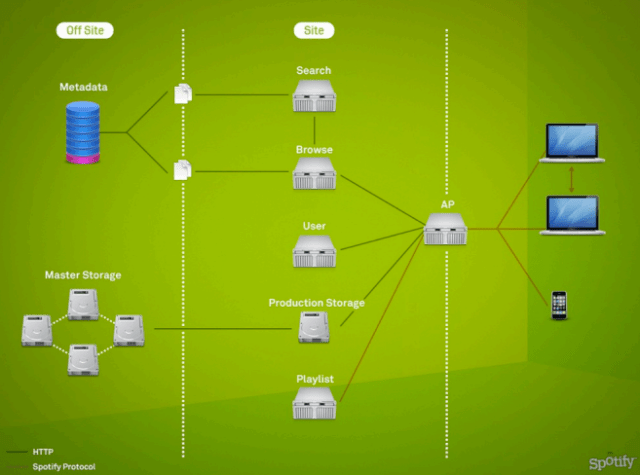
The early Spotify engineer also made reference to Spotify’s speed, and explained how Spotify works in engineering terms across a distributed system, and presumably, judging by slides, how the company combines consistency, tolerance, and partition tolerance for maximum efficiency. Image below.

All in all, the deck is a cool glimpse into the presentation that Aslund, and perhaps other early Spotify engineers are using to go out and recruit top talent at local universities.
Source:http://techcrunch.com/2012/04/25/17-million-users-and-tracks-later-leaked-spotify-recruitment-deck-offers-peek-at-first-sketch-of-ui/

Opera 12 Beta Launches, Loses Voice, Unite and Widgets


opera_skins
Opera is launching the first official beta of the next version of its desktop browser today. As usual, the Opera 12 beta includes a number of new features and enhancements, but this release also marks the end of some of the company’s more ambitious projects. With Opera 12, the company is ending support for Unite, the browser’s built-in personal cloud/streaming media platform that made its debut in 2009, and Opera Widgets. Opera is also phasing out support for its built-in speech recognition, text-to-speech and VoiceXML technologies.
This release isn’t just about removing features, though. Far from it. Among the new features is a new engine for writing and displaying browser themes (Opera previously called these ‘skins’). In addition, this version now runs plugins as separate plugins, similar to what most of its competitors are doing already. Thanks to this, a crashing plugin can’t take the whole browser down anymore.
Other new features include support for HTML5 drag and drop, support for the Do Not Track header and opt-in hardware acceleration and WebGL.
Opera is also making some low-level changes to improve the browser’s load times and launching 64-bit versions for Windows and Mac.
Among Opera’s more ambitious recent projects is definitely Opera Reader, which aims to create a new reading experience for the Web and make it look more like traditional books. With this release, Opera is opening this project up for standardization as CSS3 Generated Content for Paged Media.
For developers, this version adds improved support for CSS3 animations and transitions and cross-origin resource sharing. This new version now also supports getUserMedia to access the browser’s camera.
Source:http://techcrunch.com/2012/04/25/opera-12-beta-launches-ends-support-for-unite-widgets-and-voice/